
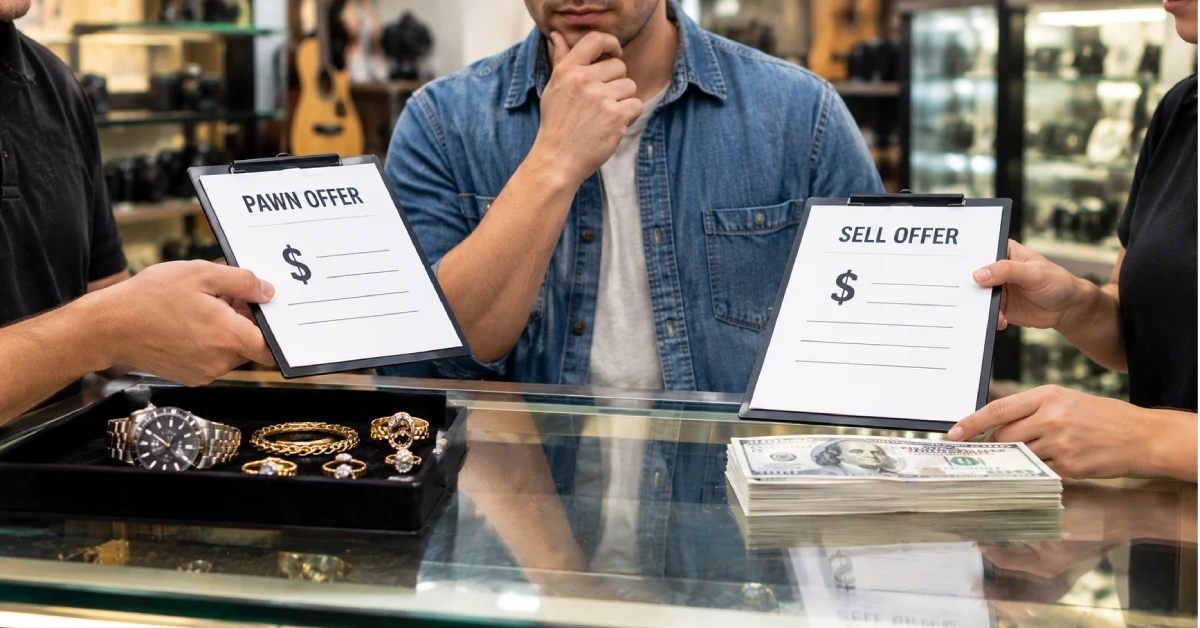
If you are thinking about taking jewelry, gold, a watch, or another valuable item to a pawn shop, one question usually comes up quickly:
Do you get more money pawning or selling?
There is no single answer.
Sometimes a sale offer may be higher than a pawn loan offer because the shop is buying the item outright. In other cases, the difference may be smaller.
Don’t base the right choice on the amount alone.
You also need to think about whether you want the item back.
What Is the Difference Between Pawning and Selling?
The main difference is ownership.
Pawning
When you pawn an item, you use it as collateral for a loan. The shop holds the item while the loan is active. To better understand this process, take a closer look at how pawn loans work. If you repay the loan on time, you can get the item back.
Selling
When you sell an item, you permanently transfer ownership. You receive payment, and the transaction is complete. You don’t have to repay anything, but you won’t get the item back later.
Why Might Selling Pay More Than Pawning?
A sale and a pawn loan are different types of transactions.
When a shop buys an item outright, it becomes the owner and can eventually resell it.
With a pawn loan, the item is held only as collateral.
Because of that, a purchase offer may sometimes be higher than a loan amount. Read our detailed breakdown of the pawn vs sell difference to see how transaction structures affect bottom-line offers.
However, that does not mean selling is always the better choice.
If you want the item back, reclaiming it may matter more than getting the highest possible amount today.
Does Pawning Always Pay Less?
Not necessarily in every case. The amount offered depends on the item and how pawn shops determine item value. Factors may include:
- Current resale value
- Condition
- Brand
- Demand
- Materials
- Authenticity
- Market trends
- Whether the transaction is a loan or sale
The best way to know is to ask about both options.
How Much Do Pawn Shops Usually Offer?
There is no universal percentage that applies to every item. Different categories behave differently.
A pawn shop evaluating what pawn shops buy will examine:
- How much the item could realistically resell for
- How quickly it may sell
- How much demand exists
- How much risk is involved
- The condition of the item
- The cost of authentication or testing
The original retail price is usually not the same as current pawn or resale value.
Does the Type of Item Matter?
Yes. Some items have stronger resale markets than others.
- Gold: Gold has an established underlying metal value, so purity and weight matter.
- Jewelry: Jewelry may be valued based on gold or platinum content, gemstones, brand, design, and condition.
- Diamonds: Diamond value may depend on carat weight, cut, color, clarity, certification, and demand.
- Luxury watches: Luxury watch value depends heavily on brand, model, reference, condition, originality and market demand.
- Estate and Designer Pieces: Vintage pieces, signed estate jewelry, and recognizable designer hallmarks often carry collector demand and historical craftsmanship value beyond simple scrap metal weight.
Do You Get More Money Selling Gold Than Pawning It?
You may receive a higher immediate amount for an outright sale, but that is not guaranteed. More importantly, the two options serve different goals.
If you sell gold jewelry, you give it up permanently.
If you pawn it, you may be able to recover it after repaying the loan. A major factor is knowing how much your gold jewelry is worth before accepting an offer.
If the item is sentimental, getting it back may be worth more than a slightly higher offer.
Do You Get More Money Selling Jewelry Than Pawning It?
The same principle applies.
If a shop is buying the jewelry, its offer may differ from a loan offer. But jewelry can have emotional value that gold bars or coins do not.
For example, a diamond ring may be worth more to you personally than its resale value suggests.
If you might regret selling it, taking out a loan against jewelry may make much more sense. Many clients ask, can you use jewelry as collateral for a loan? The answer is yes—it is one of the most common ways to secure short-term funding without forfeiting personal assets.
What If the Item Has Sentimental Value?
This is one of the biggest reasons not to make the decision based on money alone.
Before selling, ask yourself:
- Was this item inherited?
- Was it a gift?
- Is it connected to a milestone?
- Would I regret losing it?
- Could I replace it later?
If you hesitate, consider whether a pawn loan is a better fit.
What If I Do Not Care About Getting the Item Back?
Then selling may be simpler.
Selling may make sense if:
- You no longer use the item
- You do not want to repay a loan
- You want a one-time transaction
- You are clearing out unwanted valuables
- The item has little sentimental value
For example, an old gold chain you haven’t worn in years may be easier to sell than a family heirloom. If you have fine items you want to turn into direct payout, check out what Gold & Treasures Boutique Pawn buys to see if your items qualify.
Can You Ask for Both a Pawn and Sell Offer?
Yes, if the shop offers both options. This can be useful because it lets you compare:
- The loan amount
- The outright purchase amount
- The repayment obligation
- Whether keeping the item matters to you
If you hold a high-value timepiece, reviewing the tradeoffs of pawning vs selling a luxury watch gives you an accurate snapshot of how shops calculate both figures.
What Affects the Offer?
Several factors can influence both pawn and purchase offers.
- Condition: Better-condition items may resell more easily.
- Brand: Recognized luxury brands can have stronger resale demand.
- Materials: Gold, platinum, diamonds and gemstones can add value.
- Authentication: Higher-value items need to be genuine.
- Market demand: A valuable item can still be difficult to sell if buyer demand is weak.
- Completeness: Boxes, papers, certificates, extra links and accessories may help with certain items.
Does the Original Purchase Price Matter?
Only to a limited extent. A piece bought for $5,000 may not be worth $5,000 in the resale market today. Retail prices often include:
- Store markup
- Marketing
- Packaging
- Warranty
- Service
- Brand premium
A pawn shop focuses more on the item’s current resale value.
What If the Item Is Broken?
Broken items can still have value depending on what they are made from.
Examples include:
- Broken gold chains
- Damaged rings
- Single earrings
- Bent bracelets
- Non-working luxury watches
Gold and precious metals can retain material value even when the item is damaged.
Whether the piece is better suited for a loan or sale depends on its overall value and the shop’s policies.
How to Decide Between Pawning and Selling
A simple way to decide is:
Choose pawning if:
- You want the item back
- It has sentimental value
- You need temporary access to cash
- You are comfortable with the repayment terms
Choose selling if:
- You no longer want the item
- You want a one-time transaction
- You do not want repayment obligations
- You are comfortable giving up ownership permanently
Is Pawning Better Than Selling?
Neither is automatically better.
Pawning may be better if keeping the item matters.
Selling may be better if maximizing immediate cash and closing the transaction matters more.
The right choice depends on your situation.
Questions to Ask Before You Decide
Before agreeing to anything, ask:
- What is the pawn loan offer?
- What is the outright purchase offer?
- How was the item valued?
- What fees apply to the loan?
- When is repayment due?
- What happens if I do not repay?
- Is the sale final?
Understanding both options helps you avoid deciding based only on the first number you hear.
Looking to Pawn or Sell an Item Near Lafayette?
Gold & Treasures Boutique Pawn serves customers in Carencro, Lafayette, and surrounding communities who want to explore options for eligible valuables, including estate jewelry, fine gold, diamonds, and luxury timepieces. You can also view our curated inventory gallery to get a sense of the fine items we handle.
If you have gold, jewelry, diamonds, watches, or another valuable item, you can ask about both a pawn loan and an outright purchase.
Contact Gold & Treasures Boutique Pawn to compare your options before deciding whether to pawn or sell.